Objective
Our family traditions are very important for the evolution and development of children, since through our rituals we transmit to them norms of conduct, values, and unity. Customs originate in the family nucleus; being a solid foundation for their future as it will help them create their way of thinking, feeling, and acting. With this activity we seek to help your children learn about the invaluable Mexican tradition of the Day of the Dead; and how this celebration does not represent an absence but a living presence, death is a symbol of life that is materialized in the altar that is offered.
Materials
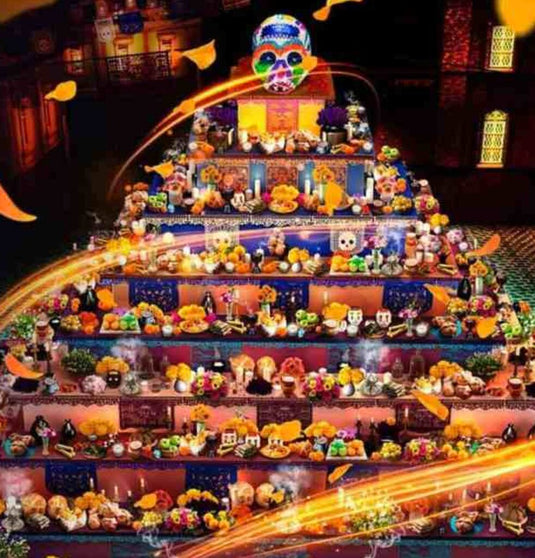
For this activity, children can choose to create their own altar with real materials, draw their own altar, or even make one with playdough or recycled materials. There's no limit to their imagination. They can also use the images we've attached as inspiration.
- Colors
- Scissors
- Glue
- Drawings made by children or photographs of family members or pets who have passed away and that they want to remember.
- Pencil and paper
- Cardstock to glue the cut-out images onto.
- Cardboard box or black paper on which to place the images.
- Colored modeling clay
- Materials for recycling
Activity
1. Show your children a real image of an offering and ask them to tell you: what elements do they see on the altar? What colors are used? What do they think the altar is for?
2. Using the materials you have at home and depending on the age of each child, create your own altar. You can draw pictures, make clay figures, cut out the images we have attached and paste them onto cardstock or inside a cardboard box previously lined with black, use recycled materials you have at home, etc.
3. Don't forget to include a photo or drawing of that special person or pet who is no longer with us. You can ask your children to draw the person or put the photo and they can make the frame.
4. Finally, ask them how they feel about that special person no longer being there. Ask them to say, draw, or write 3 good things about that person and/or 3 things they are grateful for. If possible, they can place the letter next to that special person's photo on the altar.
RECOMMENDATION
Here are some suggestions for when you explain the Day of the Dead altar tradition to your children:
- It is to welcome the spirits with natural elements and guide them to the homes of their loved ones with the light of candles, and once there, enjoy the feast that has been prepared for them with their family.
The offering is usually placed on the night of October 31st to welcome the souls of the children who arrive on November 1st; on November 2nd, the adults arrive, so you should remove it by November 3rd. - It is the day when all Mexicans celebrate the memory of the people who are no longer with us in this world, and one way to do so is with the offering. In the offering, our loved ones and pets are honored in a very special way.
While you set up your own altar, take the opportunity to involve your children and ask them how this tradition makes them feel. If possible, make this Mexican tradition a family tradition.
I ask you to close your eyes and think about the tooth fairy, the tooth fairy, as well as when you played airplane, Doña Blanca or the little onions, I'm sure you'll feel a sense of happiness and well-being, you're probably smiling.
And this is because we have an invisible bond, something very strong that unites us with our roots. This legacy that we pass down from generation to generation is one of the simplest and safest ways to transmit values and ways of life to children. And above all, to respect them, since knowing them is respecting them.
These traditions reach our children through play. This becomes part of their very essence, through which they begin to perceive and know the world around them in a symbolic—and later real—way. This method of transmitting traditions fosters cognitive, social, emotional, and communicative development. Traditional games promote a sense of belonging, transmit family and cultural values, and facilitate and sharpen memory, imagination, and creativity.
So paint, build together, and most of all, enjoy this time very much.